- 1-855-4JOEYDI / 1-855-456-3934
- This email address is being protected from spambots. You need JavaScript enabled to view it.
The Lt. Joseph P. DiBernardo Memorial Training Seminar included three days of life-saving firefighter training!
The 2026 Lt. Joseph P. DiBernardo Memorial Training Seminar offered world-class firefighter training taught by fire service leaders. This great weekend of fire department training not only helped firefighters to develop their skills, it also benefited the Lt. Joseph P. DiBernardo Memorial Foundation’s grant program. Our grant program helps fire departments in need provide Personal Safety Systems (PSS) to their firefighters.
Download Flyer
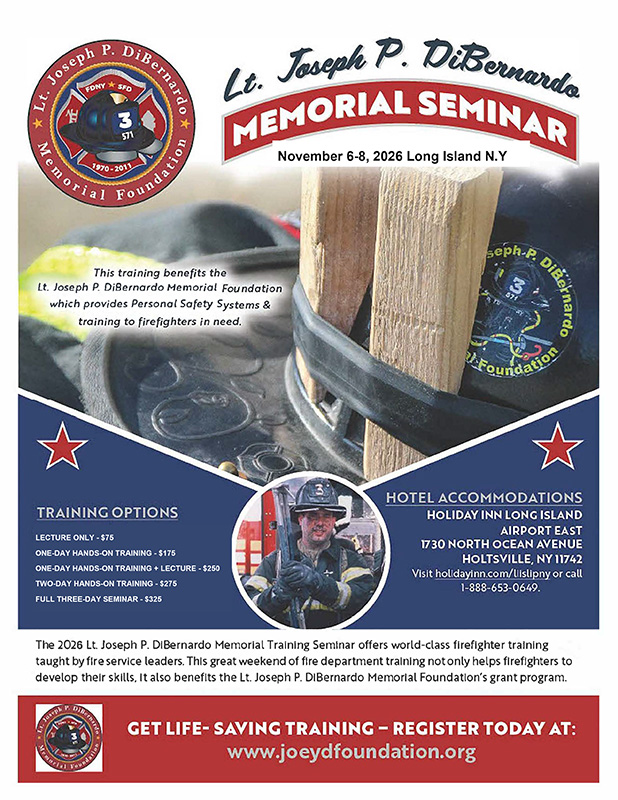
Friday and Saturday November 6-7 2026
Two Days Hot at one of these locations:
Suffolk Fire Academy
102 East Ave
Yaphank NY 11980
Nassau Fire Service Academy
300 Winding Road
Old Bethpage NY 11804
Hagerman Fire Training Facility
510 Oakdale Ave
East Patchogue NY 11772
Riverhead Fire Training Facility
1596 Northville Tpke
Riverhead NY 11901
SUNY Stony Brook - Elevator Class
101 Nichols Road
Stony Brook NY 11794
Sunday November 8, 2026
Lectures:
Centereach Fire Department
9 South Washington Ave
Centereach NY 11720
Training Options
LECTURE ONLY – $75
ONE DAY HANDS-ON TRAINING - $175
ONE DAY HANDS-ON TRAINING + LECTURE - $250
TWO DAY HANDS-ON TRAINING - $275
FULL THREE-DAY SEMINAR - $325
Hotel Accomodations
HOLIDAY INN LONG ISLAND/ AIRPORT EAST
1730 NORTH OCEAN AVENUE
HOLTSVILLE, NY 11742
Additional hotels are available in the area
Join us for another year of hands-on training at the 2026 Lt. Joseph P. DiBernardo Memorial Training Seminar. All hands on training programs require a minimum certification of Firefighter I.
Train for your next response with hands-on opportunities including:
Full Day Programs
Commercial Fire Operations with OSTA – Full Day Program
Lead Instructor: On Scene Training Associates (OSTA) Aaron Heller Hamilton FD NJ ret.
This program is designed to enhance firefighter’s skills at the scene of Commercial Structure
Fires. Instructors from OSTA will be passing on knowledge through a rotation of skills some of
which include; Hose handling, Access and Egress, Forcible Entry, Saw Operations, Laddering,
VEIS, Search and Communications. Attendees will definitely build on their current knowledge
and skills while learning new tricks of the trade by some of the best instructors from around the
Country.
“Be That Guy!” – Saving Yourself & Others
Lead Instructor: Battalion Chief John Cagno North Providence FD & Captain Tony Tricarico FDNY ret.
This class is designed to give firefighters techniques and simple actions to save yourself, or
another member in a rapid manner using just the common tools and basic equipment carried by
members on the fire ground. This is not a RIT operation; this is about keeping yourself and/or
your crew alive. Students will be shown and then challenged to perform various techniques that
you may encounter on the fire ground.
First Due Response Tactics
Lead Instructor: Chief Mo Davis Houston FD
This program will have you performing tactics that must be implemented on a first due response.
Students will work in smaller skills groups on different evolutions that will help hone your skills
for the overall success of the mission. Depending on student count and abilities some of skills
and tactics may include proper tool use and allocation, forcible entry, laddering, VEIS, search,
victim drags and removal and hose line stretches into a live fire condition. As a trained
professional you should be focused on the overall mission of increasing the chances of survival
for the victim. If you are a skilled firefighter looking to enhance your operational level or a
newer member this is a program for you.
Elevator Rescue Operations – Saturday Only @ SUNY Stony Brook
Lead Instructor: Dragon Rescue Management Mike Dragonetti Stamford CT FD ret.
This one-day program is designed to enhance the firefighter awareness and knowledge with
elevator emergencies and rescue. Students will have an interactive classroom discussion on
hazards involved when dealing with various elevators, various techniques that should be utilized
and how to keep everyone safe during these responses. Once the classroom program is
completed the students will be guided to various types of live elevators in a high rise building to
review lessons discussed and taught in the classroom. Instructors from Dragon Elevator
Management and elevator companies will guide the student safely during this program.
Half Day Programs
Residential Fires - Live Fire
Lead Instructor: SCFA Instructors
Firefighters will perform various evolutions designed to develop skills on the fire ground at
residential structure fires. Many skills will be taught and performed including; Hose handling,
Forcible Entry, Laddering, VEIS, Search and Communications. There will be live fire with
smoke and heat conditions in the County burn building with seasoned instructors guiding you
through each evolution.
Commercial Fire Operations -Live Fire
Lead Instructor: SCFA Instructors
Firefighters will perform various evolutions designed to develop skills on the fire ground at
commercial structure fires. Many skills will be taught and performed including; Hose handling,
Forcible Entry, Laddering, VEIS, Search and Communications. There will be live fire with
smoke and heat conditions in the County burn building with seasoned instructors guiding you
through each evolution.
Fire Behavior for the Modern Fire Environment
Lead Instructor: FlashFire Industries Dan Gordon FDNY
This isn’t just about flashover and the modern fire curve! This course is designed for the
firefighter to increase their knowledge on what is actually happening around them in a fire
building. The course will begin with a short classroom presentation followed by a rotation of
live burns that demonstrate each and every aspect of the presentation under real fire conditions.
Students will see firsthand changes on the fire ground including; fire growth, proper and
improper ventilation, oxygen limited fires, roll over, flashover and more! Students will also
operate with a Thermal Imaging Camera and proper use of the CAN!
Forcible Entry
Lead Instructor: East Coast Rescue Solutions Chris Minichelli FDNY
Firefighters encounter many obstacles when trying to enter in to a fire building to save lives and
get water on the fire quickly and efficiently. This program is designed to enhance firefighters’
skills on forcing doors, cutting locks and roll down doors to enter as quickly as possible.
Various tools and techniques will be addressed by experienced instructors from East Coast
Rescue Solutions.
FIREFIGHTER DOWN – RIT/Firefighter Rescue with FAST Rescue Solutions
Lead Instructor: FAST Rescue Solutions Eric Allen Philadelphia FD
This course is designed for the Firefighter and Fire Officer to enhance their ability to operate
proficiently as a Rapid Intervention Crew. Students will go through various stations utilizing
different equipment and rescue techniques in zero visibility to save our own. The following
skills will be covered Air Management, Emergency Communications, Downed Firefighter
Removal Techniques and Self-Survival Skills.
Search Operations
Lead Instructor: SCFA Instructors
This program is focused on the firefighter’s ability to perform and demonstrate a high level of
competency performing a primary search in a structure with maze like conditions. The
firefighter will be coached on conducting a proper primary search in zero visibility, with heat and
stressors searching and possibly removing a victim to safety. The firefighter will also perform a
search utilizing a search rope to locate and remove a victim. Are you prepared and have you been
working on improving your skills on search operations? This program can help you hone in your
skills and help you get extremely comfortable utilizing your SCBA.
Tactical Actions Before a Last Resort Bailout
Lead Instructor: Chief Donald Colarusso and All Hands Fire Training Staff
Firefighters often operate in high-risk environments, requiring constant situational awareness and
the ability to recognize rapidly changing conditions. Students will review aggressive search
techniques, navigation through small and cluttered spaces, and the actions necessary when fire
conditions deteriorate suddenly. A key focus will be on emergency egress options, including
ladder bailouts and hands-on training with Personal Escape Systems. Participants will learn to
exit rapidly under stress by quickly deploying their escape systems, establishing secure anchors,
and performing controlled window bailouts. Practical, scenario-based drills will build
confidence and prepare firefighters to act decisively when seconds count.
Thermal Imaging
Lead Instructor: Andrew Dinkel FDNY, Assistant Chief Suffolk County Fire Academy
Firefighters across the country now have Thermal Imaging Cameras in their department and are
required to have proper training on its proper use. This program you will learn from experienced
instructors who will offer you years of practical experience on utilizing the Thermal Imaging
Camera. This program will begin with a classroom presentation and followed with various
hands on instruction in a live fire environment. See what you have been missing when looking at
the image on the camera.
Hose Loads and Flow Bros - sponsored by Elkhart Brass and Mercedes Hose
Lead Instructors: Bill Eletto Elkhart Brass, Caleb Langer Mercedes Textiles, Lt. Mike Magerle FDNY (Ret.)
Ready to sharpen your engine company skills? This fast-paced, hands-on class is designed to
build confidence and efficiency in hose deployment and fireground water application. Students
will train on the flat load, Minuteman, and the FDNY horseshoe, learning when and where each
stretch provides the greatest advantage. Through realistic hallway and building evolutions,
participants will advance and flow charged hose lines while focusing on teamwork,
communication, nozzle control, and hose management. Whether you're a new firefighter or a
seasoned veteran, you'll leave with proven techniques to make faster, smoother, and more
effective stretches when every second counts.
Heavy Lifting & Moving Advanced Stabilization
Lead Instructor: Jason Bernfeld - Strategic Safety
This class is design to challenge the firefighter with difficult extrication scenarios that are not
everyday occurrences. Vehicles are staged in precarious positions with viable victims trapped
that must rely on proactive firefighters to save them. Students will use various tools and
equipment while utilizing proven techniques under the guidance of seasoned instructors to
successfully extricate the victims.
Lithium-Ion Battery Fires
Lead Instructor: Randy D’Arcy
Battery fires have been increasing in the last few years and have become a hot topic for
firefighters, local governments and code officials. Firefighters have been faced with quick
intense fires and sometimes rapidly intensifying fires and explosions while operating. This
course will surely enhance your knowledge of how these batteries work, cause fires and how to
operate accordingly. The program will start with a baseline of information in the classroom and
then out to the field where the instructors will show you how these batteries ignite and burn.
Basement Fires/Flashover
Lead Instructor: SCFA Instructors
Just stretching a hose line into a basement is not always as easy as it seems! Students will be
rotated through to challenge the engine company firefighter and enhance their knowledge on the
importance of getting the line into operation quickly and efficiently. Students will be stretching
1 ¾’ and 2 ½” lines around obstacles and operating in live fire conditions. Students will operate
hose lines at a basement fire under live fire conditions and learn how fires rollover and flashover
in the Flashover Simulator.
Eyes in the Sky: Tactical Drone Operations for Firefighters
Lead Instructor: Captain Mike Leo FDNY Drone Unit
When a call comes in, split-second decisions dictate how an incident plays out. Fire service
drone programs put real-time, overhead context right into the hands of incident commanders
before crews ever step foot into danger.
Using thermal cameras and high-def zoom lenses, flight teams can slice through pitch-black
smoke to spot hidden hotspots, trace roof compromises, or find lost hikers in dense woods.
Whether it's reading a hazardous material label from half a mile away or tracking a brush fire's
movement in real time, drones serve as a force multiplier—keeping firefighters safer and helping
teams operate faster when every second counts. This program will give firefighters. officers and
incident commanders a basic understanding of how drones can be put to good use at any
emergency operation.
No Excuse Aerial Operations
Lead Instructor: Chief Larry DiCamillo Stafford FD (ret.) – “C” Side Consultants
Aerial operations can be the cornerstone to of a positive outcome for rescue and/or fire
suppression, but it all starts by having proper training and mindset of the chauffeur. Are you
thinking three steps ahead and preparing for the unexpected? There should be no excuse when it
comes to positioning, setup or operations. You must be prepared and understand what you can do
with your apparatus while understanding the importance of its limitations. This program will set
you above the rest and ensure that the aerial will do the job when needed when you are the
chauffeur.
Truck Company Roof & Outside Vent Operations
Lead Instructor: Bob Lee – FDNY Captain (ret.)
This course aims to equip firefighters with the essential skills and knowledge required to perform
critical roof & outside vent operations safely and effectively. Whether you are a seasoned
veteran or a newer firefighter you will learn or enhance your knowledge from experienced
instructors. Students will work through different skills understanding the importance of
coordinating ventilation with inside operations, power saw operations, basic hand tools,
laddering and proper size up for safe operations. This program is designed to ultimately
enhancing their capabilities as an effective and skilled member of a truck company.
Technical Rescue Programs
First Due Car vs Building
Lead Instructor: Dan Gordon – FlashFire Industries
Over 100 vehicles crash into buildings every day. Are you prepared? This course will walk you
through common sense and basic emergency shoring that can be done with minimal equipment
and rapidly deployed while rescue operations are being conducted. Fire departments routinely
train on extrications and lifting procedures - but are you prepared when those rescues involve
structural stability concerns.
Man vs Machine - Industrial Rescue
Lead Instructor: PL Vulcan, Battalion Chief Mark Gregory FDNY
Whether it is a basic ring removal, a person with their arm stuck in a snow blower or a full
entrapment involving agricultural equipment, our instructors will guide you through the
necessary steps to perform these extrications. Students will perform safe removal operations at
different skills stations with basic equipment.
Trench Rescue
Lead Instructor: RPM Rescue Captain Mike O’Hare Houston FD
Trench and excavation rescues are extremely dangerous emergencies that can happen anywhere
and at any time. This program is designed for firefighters trained in technical rescue, work in a
support roll or are interested in being on a technical rescue trench team. Students will discuss the
hazards of these operations, utilize various equipment and remove a victim from a trench.
Confined Space Rescue
Lead Instructor: RPM Rescue Captain Mike O’Hare Houston FD
60% of would-be rescuers die when attempting to rescue a worker in a confined space. This
program is designed for the technical rescue firefighter to enhance their knowledge of confined
space emergencies. Various techniques will be shown and performed by the student in our
confined space simulator. This is a great opportunity to complete your annual refresher or
enhance your skills with experienced instructors.
Rope Rescue Operations
Lead Instructor: RPM Rescue Captain Mike O’Hare Houston FD
Rope Rescues are becoming more common with the number of taller buildings and older
buildings that need repairs. This program will give students the opportunity to perform actual
rescues from an elevated position. Students will learn various techniques and perform raises and
lowers of victims in distress including window washers trapped by a dangling scaffold.
Full Day Program – Nassau Fire Academy
Naut110 - Basic Shipboard Firefighting and Safety – USCG Approved
Lead Instructor: Nassau FSA Instructors
Course Description: This course provides the student with the knowledge and experience
of responding to shipboard fires and emergencies. The student will be instructed in the
behavior of fire, fire prevention and suppression techniques, and associated extinguishment
systems found aboard various types of vessels including container ships, break bulk, oil
tanker, chemical tanker, LNG, RO-RO and passenger vessels. Students will be shown how to
use fire prevention and suppression equipment properly and effectively in dealing with fires
and hostile environments. Students will also be instructed in the safe use of respirators, the
subject of fit testing of respirators, and the use of the SCBA in firefighting. This course is
designed to give the students the necessary skills to minimize the risk of fire and maintain a
state of readiness for combating shipboard fires. This course also includes a one-day training
exercise at an U.S. Coast Guard approved Shipboard Fire Training Facility*. This course is
required of the International Convention on Standards of Training, Certification and Watch
keeping for Seafarers and includes the 2010 Amendments. All competencies must be
successfully completed. Additionally, successful completion of this course is a requirement
for graduation.
Learning Process Goals and Objectives: This Course is designed to make the student a
safe member of the shipboard firefighting team with the ability to determine the capabilities
in the event of a fire or emergency aboard ship. The objectives are accomplished through a
series of labs and a 1-day field training exercise at USCG approved shipboard fire training
facility*. The 1-day field training exercise is a live fire evolution, and students will
extinguish fires utilizing various extinguishing agents and firefighting equipment including
the SCBA. Learning Objectives include:
• Minimize risk of fire
• Maintain a state of readiness to respond to shipboard fires and emergencies
• Prevent, control and fight shipboard fires
• Combat Class A, B, C and D fires
• Operate basic firefighting apparatus, including hose-lines, portable foam apparatus
and portable fire extinguishers. Understand the detection and fixed extinguishment
systems found aboard the various types ofships including container, break bulk, oil
tanker, chemical tanker and passenger. • Understand the danger of confined spaces aboard ship
• Safe use of respirators to include filter masks and the Self-Contained Breathing
Apparatus (SCBA) Proper use and wearing of the shipboard firefighter’s PPE
Half Day Programs – Nassau County Fire Academy
Garden Apartment Fires - Live Fire - “Response to Occupied Multiple Dwellings”
Lead Instructor: Nassau FSA Instructors
Students will receive real-world training in a real-world environment. Firefighters will
experience the challenges of response to and operations at garden style apartments / occupied
multiple dwellings.
Topics to be discussed will consist of, Hose stretching, ladder placement, roof operations,
building construction features and forcible entry.
The Tower - Live Fire - Fire operations in “High-Rise Buildings”
Lead Instructor: Nassau FSA Instructors
Morning session: “Residential High-Rise Fire Operations”
Students will be faced with the challenges of fire operations in high-rise residential non-fireproof
buildings. The emphasis will be on engine company stretches in this type of occupancy. Ladder
company responsibilities, the use of fire escapes for egress and access. Incident command and
accountability.
Afternoon session: “Commercial High-Rise Buildings”
The focus of this session will be based upon response to and operations at High-rise Commercial
building fires. This fireproof, windowless, ventless operation will illustrate the challenges of
high-rise commercial firefighting. Firefighters will have the opportunity to learn the importance
of good coordination between the engine company and a truck company as well as the
importance of the bulkhead in the control of the interior stairwell.
The Split - Live Fire - “Response to Peak Roof Wood Frame Private Dwelling fires”
Lead Instructor: Nassau FSA Instructors
Participants will be faced with the challenges of our “bread-and-butter operations”. Rapid size
up, strategies and tactics of private dwellings will make or break an operation. Students will
experience the importance of aggressive interior searches while operating in coordination with
the engine company. Below grade fires present a unique set of challenges for the first arriving
engine and ladder company. Firefighters will be presented with the opportunity to experience
basement / cellar fires in private dwellings.
The Warehouse - Live Fire - “Taxpayer Fires” - Big fire-big water
Lead Instructor: Nassau FSA Instructors
Students will have the opportunity to work in a one-story class 3 row of Taxpayer type
occupancies and respond to the “Big Box Retail” evolution. Students will experience some of the
many challenges of commercial firefighting. The firefighter will have the opportunity to learn
and operate within the sprinkled compartment of commercial buildings. “Cutting the row” and
operation of the large caliber hose streams. The discussion of firewalls designed, and undesigned roof loads are just some of the takeaways from this informative evolution.
LPG Emergencies - Live Fire - BBQ and loading dock emergencies”
Lead Instructor: Nassau FSA Instructors
Firefighters who attend this session will participate in two actual field experience sessions.
During the briefing firefighters will learn; characteristics of material, safety regulations for
transport and storage, NFPA markings and identification of 20- and 100-pounds cylinders.
During the field that evolution to firefighters participate in fire ground activities designed to
control fire and manage leaks.
Pumping Operations
Lead Instructor: Chris Howard FDNY – Nassau (FSA) Fire Service Academy
The fire service has experienced many changes in how we operate over the past 50 years- Bunker
gear, thermal pane windows, SCBA usage. Some of these changes have been identified as they
were happening and training was changed to keep up. The transition from a throttle and relief
valve set up, to a pressure governor on our engine companies was one of these changes. A
paradigm shift is needed for an Engineer to properly supply handlines on the fire ground. We
will go more in depth to explain some of the common mistakes made on the fire ground and
teach why this continues to happen. This class will explore the differences in the process to
properly supply and pressurize handlines on the fire ground. The difference between pressure
and volume in a two-stage pump, as well as identifying nozzle reaction as an issue in some cases.
Teaching our chauffeurs to understand how the pressure governor works through engine cues,
relationship of gauges, identifying how much volume of water is available, and the difference
between using tank water or a positive water source are all identified and explained. The class
will also give the student the knowledge to choose between the backstretch or inline pumping,
depending upon hydrant location and manpower availability, as well as the knowledge to choose
the proper intake to leave the front of the building clear for aerial apparatus. The hands-on
portion will take all of the concepts explained and show the student in a real-world situation how
the pressure governor behaves in multiple scenarios and allows the student to operate and learn.
Setting Up for Success
Lead Instructor: Battalion Chief Chris Eysser FDNY – Nassau (FSA) Fire Service Academy
This program will provide the answer to why we consider the tower ladder both an offensive and
defensive tool on the fire ground. The basic steps of how to use this tool to its maximum
capability will be presented in an organized approach from start to finish. The program will
emphasize the importance of getting this apparatus in position early and the advantages it can
provide the department throughout the incident. This interactive presentation will have various
discussions and then move out to the training field to set up and operate tower ladders on the
buildings to be used at their maximum potential.
2026 Joey D Seminar Lecture Descriptions
Lecture Series
Keynote:
FDNY Chief of Department John Esposito
Lecture:
Are you prepared for what could possibly go wrong at a commercial building fire?
Aaron Heller
Every jurisdiction has a wide variety of different types of structures including commercial occupancies. These range from small downtown shops to large warehouses and “big box” type buildings. We all enter these types of buildings daily sometimes just shopping or while on a response, but are you taking a good look around or doing a good size up upon arrival? This lecture will discuss some history of commercial buildings, how they are constructed, commercial structure fires and their potential for collapse. We will also review a recent commercial building fire that had a partial collapse with firefighters trapped and rescued will be discussed.
Lecture:
Down & Dirty Fireground Decision Making
Corley Moore
No short class can turn someone into the ultimate fireground decision maker, but Down and Dirty provides the tools and a framework for beginning that journey. Starting on the premise that making decisions is simple when you understand your priorities and then building from there. Just remember that simple does not mean easy! And this is just in the first twenty minutes. The remainder of the class is then spent defining fireground tactical decision making, and how to best maximize each and every attendee fireground experience, training, situational awareness and their comfort level when making decisions.
I believe there is a massive need in the fire service to prepare those who operate in decision making roles to be more decisive and deliberate on the modern fireground. To understand that decision making is based on understanding your priorities. When there is a clear understanding of this throughout an organization then you can operate at a very high level, and with intentionality. Experience, combined with training to maximize your situational awareness and enhance your comfort level. The keys to achieving this are outlined in this class. When things are hard and changing, nothing can replace a well prepared and decisive fireground commander.
Lecture:
Intro to Lithium-Ion Battery Emergencies
Pat Durham
This two-hour session gives first responders a foundational understanding of incidents involving lithium-ion batteries, electric vehicles (EVs), and battery energy storage systems (BESS). Attendees will get an overview of battery construction, failure modes, and thermal runaway hazards, along with a high-level look at suppression considerations, extrication challenges, and post-incident procedures. Real-world case studies illustrate the operational realities of these incidents. Attendees will leave with a working knowledge of the risks and response considerations for lithium-ion battery emergencies of all sizes.
Thank You to the Suffolk & Nassau County Fire Academy for their continued support of the Lt. Joseph P. DiBernardo Memorial Training Seminar.
Copyright © 2025 Lt. Joseph P. DiBernardo Memorial Foundation
The Lieutenant Joseph P. DiBernardo Memorial Foundation, Inc. (Foundation) exists to assist fire departments with their ability to purchase and train with rescue equipment. Toward that end, the Foundation does so without regard to race, religion, creed, color, gender, sexual orientation or age. The Foundation’s By-Laws, Annual Report, and Conflict of Interest Policy are available by writing to the Foundation at its home address.